November 05, 2026
Blog 3 in Digimarc’s six-part blog series about the new the C2PA standard and the role of digital watermarking to strengthen content credentials.
By Dom Guinard, C2PA Strategic Advisor and Tony Rodriguez, CTO at Digimarc
Summary
As generative AI makes it increasingly difficult to discern what’s real and trustworthy, people need auditable content authenticity and provenance information. C2PA has emerged as the leading and most widely adopted standard that addresses this challenge. It’s already embedded into cameras, smartphones, creative software, generative AI, cloud, and media infrastructure and used by news organizations, publishers, and distribution platforms across the entire content supply chain. With C2PA implementations in place across the content lifecycle, it’s fast becoming the next industry infrastructure layer every business needs to thrive in the digital world.
Key Takeaways
In the very near future, generative AI technology will become so good at creating realistic content that content consumers will find it’s literally impossible to discern which online images, video, and audio are real and can be trusted. This will result in a nagging uncertainty that will impact every sphere of human life—that is, unless we empower people with trusted provenance information for them to discern accurately and with confidence.
Many tech leaders, including the innovators at Digimarc, foresaw this future and created technologies and standards like C2PA for a brave new world: one where next-gen cameras enable users to cryptographically prove where an image came from, AI content generators identify the content they create, news organizations proactively attach verifiable provenance to images and videos, and content platforms read and display provenance information for content consumers.
Well, that future has arrived. C2PA, the open standard behind Content Credentials, is now being deployed across every stage of the digital media supply chain. The big question is, what does it mean for your business? Because one thing is certain: You don’t want to be left behind.
A few years ago, we were excited about C2PA proof-of-concepts. But not anymore. We’re seeing widespread C2PA adoption across all phases of the media content lifecycle, and by some of the biggest industries and most influential companies in the world. Let’s take a closer look.
The best place to start adding Content Credentials to an asset is at the time of its creation or capture because documenting it in real time offers the greatest transparency and the fewest opportunities for data manipulation.
Device manufacturers have taken notice and taken action. Leica took the first major step toward this reality in 2023 with the M11-P, the world’s first camera to attach Content Credentials at the point of capture. The camera cryptographically signs information about the image, establishing provenance from the beginning of its lifecycle. Since then, the rest of the camera industry has followed suit, or is in the process of doing so. For example:
Having provenance data capture built into professional cameras is critical, as journalists and governments use these devices to take images and video published by departments and news sites. But content provenance is rapidly moving from specialist cameras used by photojournalists to devices carried by millions of ordinary consumers: their phones. And just in time because today, 90% to 95% of all new photos/images captured are taken with personal mobile devices.[1] Did you know that:
C2PA adoption by generative AI and creative software providers is remarkably broad today, in part because new legal frameworks (such as the EU AI Act, explored in our first blog in this series) mandate that these companies to disclose AI-generated or modified content.
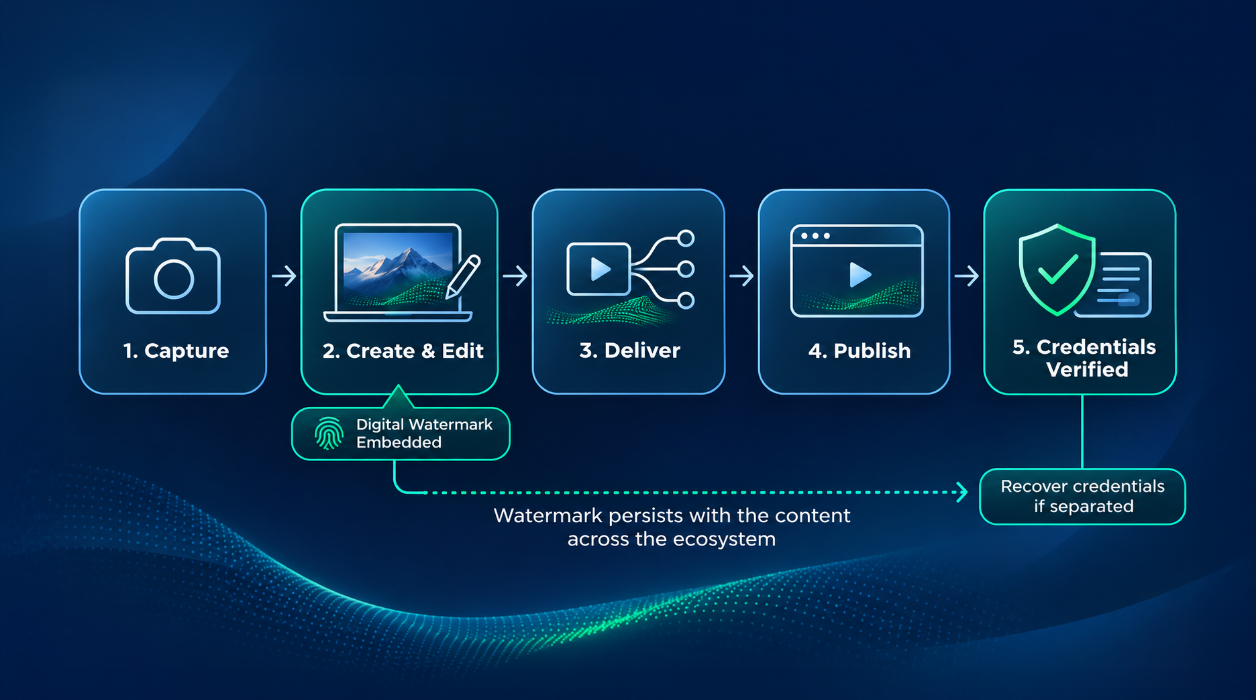
Tracking modifications using Content Credentials is critical because content rarely travels directly from a camera or content creator to a consumer. It gets edited, cropped, and saved in new formats along the way. This makes creative software a crucial link in the provenance chain (for example, so a creative tool can export video with Content Credentials carrying information about the creator and how the content was produced and modified over time).
The result is something much more interesting than isolated C2PA-enabled products: instead of provenance being replaced at every stage, each participant can contribute to a verifiable history of the asset. This is the core goal of the C2PA standard.
To understand the depth and breadth of C2PA adoption by generative AI and creative solution providers, consider the following proof points:
We’re also seeing smaller AI players support C2PA as well, such as Runway and Stability.ai (for their creative tools), Synthesia and HeyGen AI (for avatars), and Brahma AI (for digital humans). Just about every major AI player has either implemented C2PA or is about to do so.
The infrastructure between publishers and consumers routinely transforms media assets: CDNs resize images. Websites compress them. Applications change formats. And video platforms transcode files. But these transformations often remove C2PA metadata.
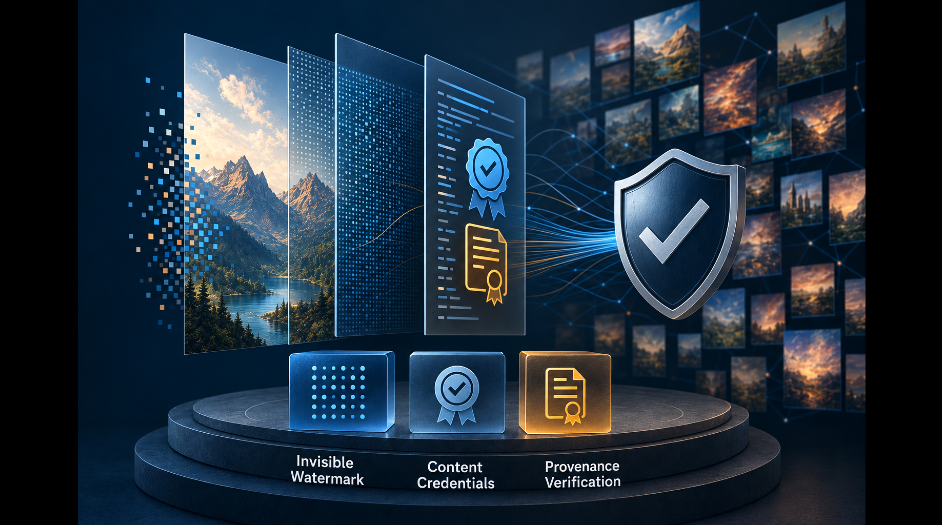
For C2PA to work at internet scale, the infrastructure that carries media must stop treating provenance as disposable metadata. This is where digital watermarks can help, as they build a strong binding between the asset and the manifest. Short of using digital watermarks everywhere, the good news is that increasingly, platforms are preserving C2PA metadata, and in some cases, adding provenance data when it is missing. For example: https://www.ezdrm.com/c2pa-video-signature-service-ezdrm
While people want and expect the “news” to deliver verified information, trust in news and media in general has never been lower. Social media has done the most to erode people’s trust in what they see online, so it’s not surprising that social media platforms are quickly embracing C2PA, along with news and media organizations around the world. For example:
To understand the power of C2PA to restore trust in digital content—and its value across the content lifecycle—consider its use by Suspilne, Ukraine’s public broadcaster.
When bad actors began using AI to generate realistic images and manipulative content for disinformation purposes related to the war, Suspilne Ukraine became first news organization in the world to bring visible Content Credentials to its readers, giving them a verifiable chain of provenance from content capture (using C2PA-enabled Sony cameras to take photos and video), content creation (where images and video are added to articles), and publishing on their news site.
Its newsroom CMS validates the credential, carries it forward as images are resized or cropped, and adds signed identity assertions that prove Suspilne published the content. Readers can see Content Credentials directly on the Suspilne website. See it in action here.
As these examples illustrate, C2PA adoption is quickly going mainstream, and the value for media consumers questioning what’s trustworthy is clear.
But is C2PA mainstream yet? Not quite. Most of the content you encounter online today still doesn’t carry usable Content Credentials. Many consumers still don’t know what the Content Credentials icon means. And many workflows still strip Content Credentials if they have not been made durable by combining them with complementary technologies like enterprise-grade digital watermarks.
But the trajectory is clear: we now have a complete chain of C2PA support, and the proverbial “CC train” has left the station. With significant C2PA implementations in place at almost every point in the content lifecycle, it’s beginning to look less like a technology initiative and more like the next industry infrastructure layer that’s essential to achieving:
This is why it’s so important for businesses to invest in a way to add durable Content Credentials to digital images, video, and audio. Want to learn how? Read the second blog in our C2PA series, which explores why you can’t expect “added” Content Credentials to stay attached to digital files forever, and how you can use technologies like embedded digital watermarks to help reconnect an asset to this critical information, wherever it goes.
Have questions about how your business can get started with C2PA and durable Content Credentials? Contact Digimarc today.
Share this Blog