September 23, 2026
Gift card draining has crossed the threshold from being viewed as merely another form of gift card fraud to becoming a distinct fraud category. Dedicated law enforcement initiatives, new state laws, specialized retailer defenses, industry-specific terminology, and growing legal action all indicate that regulators, retailers, and fraud experts now recognize gift card draining as a unique criminal methodology requiring its own prevention, detection, and prosecution strategies.
For years, gift card fraud was largely viewed as a consumer scam problem: Criminals tricked victims into buying gift cards, consumers lost money, and retailers and brands were often considered bystanders in the crime.
But a new wave of litigation, consumer complaints, and industry scrutiny is changing that narrative. These cases specifically involve "card draining," which has a unique attack methodology, identifiable vulnerabilities, dedicated criminal networks, and growing legal implications for retailers, brands, gift card issuers, and processors. With cases mounting, it’s increasingly being recognized as its own fraud category.
And as losses continue to rise, courts, consumers, and regulators are beginning to ask a new question: When card draining becomes a known, preventable risk, who is responsible for stopping it?
Card draining occurs when criminals tamper with gift cards before they are purchased, and it always follows the same pattern. They blend in with customers, flying under the radar to:
Several high-profile lawsuits have elevated card draining from a nuisance fraud issue into a broader business and legal risk. And increasingly, legal arguments are centering on what a company knew, when it knew it, and whether it took reasonable steps to mitigate an established threat. Examples include:
Historically, gift card fraud discussions centered on social engineering scams where consumers were deceived into purchasing gift cards for fraudsters. Card draining is fundamentally different. The consumer is not tricked. They simply purchase a product on the store shelf that has been compromised.
When a threat becomes its own fraud category, it changes how executives, regulators, law enforcement, insurers, retailers, and technology providers talk about it and respond to it.
First, it elevates the problem from an operational nuisance to a strategic risk.
For years, gift card draining was often lumped into broader buckets such as gift card fraud, organized retail crime, consumer fraud, retail shrink, and payment fraud. When it's recognized as a distinct category, they can quantify and track it as a specific business problem. The fact that state legislatures, retailers, and law enforcement agencies are now explicitly identifying gift card tampering and draining separately shows this shift is already occurring. [ncsl.org], [wjbf.com], [security.target.com]
Second, it unlocks dedicated budgets.
When fraud is categorized and measured as a business risk, it gets funded. It’s why brands and retailers are adding tamper-evident packaging, PIN protection technologies, secure activation systems, and product authentication solutions, as well as better retail cashier training. These investments are easier to approve when there is a recognized category with measurable losses than when the problem is hidden inside a larger, generic fraud bucket.
Third, it creates accountability.
One of the biggest challenges with gift card draining has been that responsibility is often unclear. Think about it…is it the retailer's problem? The gift card issuer's problem? The processor's problem? The brand's problem?
The lawsuits noted above demonstrate that stakeholders are increasingly being asked to address the specific vulnerabilities that enable card draining. While some cases have been dismissed, once the fraud category of “gift card draining” exists in legal contexts, stakeholders can no longer claim the threat is too vague or undefined to address.
Fourth, it drives legislation and enforcement.
Fraud categories attract dedicated laws. In 2025 alone, lawmakers in 22 states introduced more than 30 bills targeting gift card-related scams and fraud targeting everything from gift card theft and forgery to gift card tampering and theft of redemption credentials. The emergence of category-specific laws, such as a new one in Georgia, is one of the clearest signs regulators view gift card draining as a unique crime, not just another form of theft.
Fifth, it changes consumer expectations.
Gift card draining scams turn consumers into victims without them having to be tricked or cajoled, and without them doing anything wrong. There’s no change in consumer behavior to modify, beyond them trying to inspect cards before they buy them. And criminals are so good at opening and resealing packs that trained cashiers can’t spot a tampered card.
The answer is better gift card security. And even a cursory review of recent articles about gift card draining reveals that customers increasingly expect retailers and card issuers to prevent fraud rather than simply warn consumers about it.
Sixth, it changes the narrative from "small theft" to "organized crime."
Perhaps the most powerful shift we’re seeing is a shift in perception. Gift card draining isn't just someone stealing a $50 card. Increasingly, investigations connect it to sophisticated transnational organized crime groups operating at scale and causing losses measured in hundreds of millions or even billions of dollars. U.S. Homeland Security, major media outlets, and fraud experts are now framing the problem that way. This is changing executive conversations from "How many gift cards were compromised?" to "How are organized criminal networks exploiting our gift card distribution and reseller ecosystem?"
And finally, it enables industry-wide collaboration and technology innovation.
Gift cards involve a sizeable ecosystem that’s keenly aware of the problem and must coordinate to help solve it. And now that it’s a distinct fraud category, multiple groups are focusing on it, including retailers, brands, card printers, card issuers, law enforcement, fraud investigators, and security technology providers. For example, Homeland Security Investigations has established efforts to identify and dismantle organized crime groups carrying out gift card draining operations.
Once everyone agrees on the fraud category, they can share data, develop and share best practices, and innovate new detection techniques and prevention technologies that can be adopted by brands, card manufacturers and networks, and retailers on the front line.
The real significance of gift card draining becoming its own fraud category is that it transforms the problem from an isolated retail loss into a recognized security threat that is measurable, prosecutable, fundable—and addressable with new security measures.
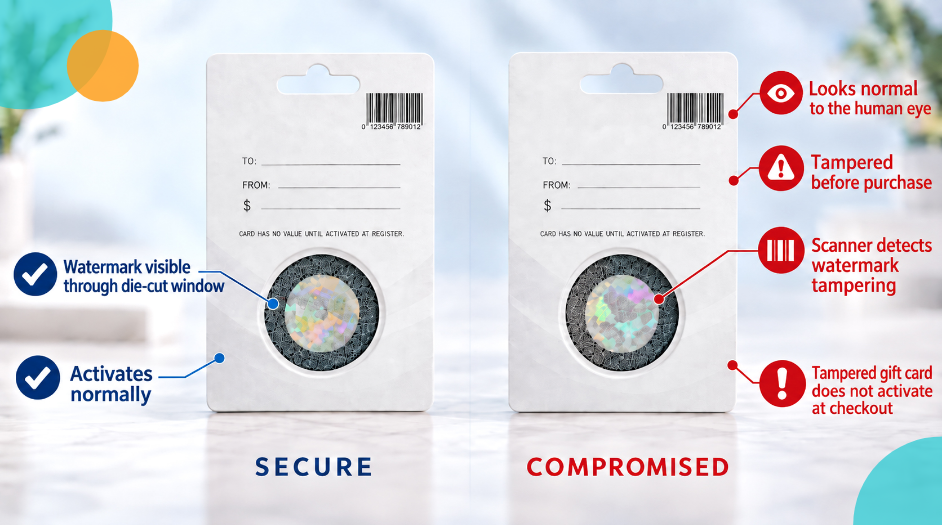
Technologies that detect tampering before activation may become one of the most important defenses available. For example, Digimarc’s next-generation, digital gift card security layer is a tamper-evident, machine-readable digital watermark that overlays card PINs or barcodes and leverages existing, front-of-store scanner devices to automate the process of tamper detection.
As shown below, cards with intact Digimarc digital watermarks scan instantly and activate normally. Cards determined to be tampered with are blocked from activation, right at the point of sale—no visual checks by cashiers required. The in-store experience is unchanged, but far more secure.
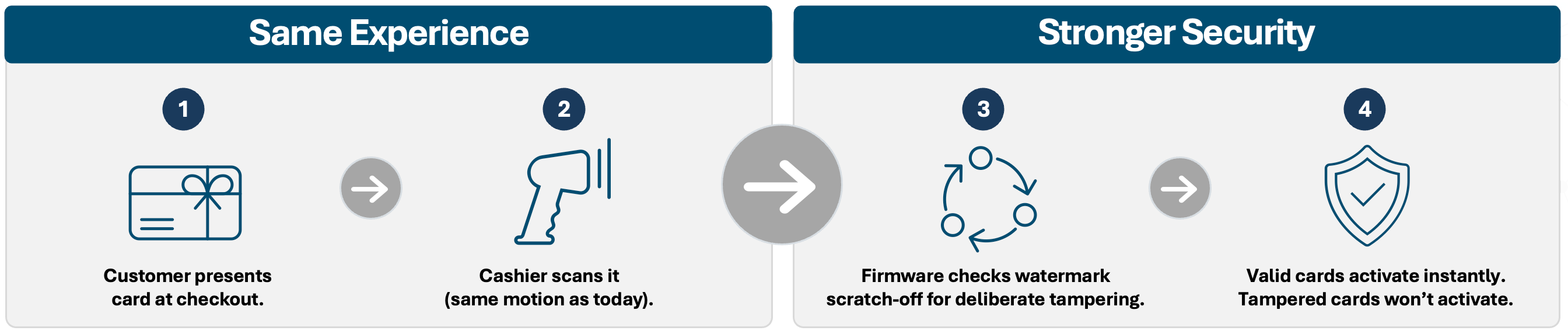
This automated approach to fraud detection and prevention restores consumer trust in physical gift card purchases and helps protect retailers and brands. According to Digimarc’s Fraud Risk Score methodology comparing our technology to traditional secure packs, gift cards protected by Digimarc technology are 3X more secure. It’s why there's been zero fraud reported on Digimarc-protected cards across U.S. pilots of our solution nationwide.
For today’s forward-looking retailers and brands, Digimarc creates an opportunity to move beyond fraud recovery and toward fraud prevention, which will keep the gift card industry thriving and customers coming back for more.
To learn more about Digimarc’s secure gift card solution, visit us online or request a time to learn more.
Share this Blog