September 29, 2026

For more than a decade, gift card security innovations have focused primarily on packaging, yet gift card fraud has continued to grow as organized criminal networks learned how to bypass physical protections and exploit the activation process itself. This blog argues that addressing today’s fraud challenges requires modernizing existing “dumb” activation systems so they can automatically detect tampered cards and prevent their activation, right at checkout. Always on the forefront of innovation, Digimarc developed a digital solution that delivers on this vision. The first big breakthrough in gift card security in years, it’s already in market with some of the biggest brands and retailers.
For years, the gift card industry responded to fraud with better packaging. Stronger adhesives. More tamper-evident labels. Tougher blister packs. Better scratch-off coverings.
And yet, gift card fraud has continued to grow. Card-related losses reported to the FTC grew roughly 364% between 2018 and 2021, demonstrating an explosive acceleration in organized gift card fraud (and this is with many victims never filing complaints). At the same time, losses have scaled as well, with some card draining scams now involving hundreds of millions, and potentially billions of dollars.
Here’s a likely root cause: while gift card security features have evolved considerably, the fundamental architecture behind gift card activation (i.e., when cards are funded) has not. In fact, you could argue that the last truly transformative innovation in gift card security was the industry's widespread adoption of activation-at-checkout well over a decade ago. Since then, most security advancements have been incremental improvements to packaging (the strongest being secure packs) rather than a rethinking of how gift cards are secured, validated, and activated.
14+ years is a long time to give organized criminal networks time to find and exploit the weaknesses of a common security architecture and industrialize their tactics. And everyone—retailers, brands, and consumers—have been paying for it.
While the rest of the gift card industry plays catch-up, Digimarc has been innovating a next-generation security solution that moves security from physical packaging into the digital realm, addressing fraud at the point of card activation.
For years, a gift card hanging on a retail rack was considered worthless until a legitimate customer purchased it and a retailer activated it through their POS system. And this control worked remarkably well. In fact, it became so foundational that the industry stopped thinking about activation itself as a security concern.
That’s why, over the next decade, security efforts shifted almost entirely toward protecting the card and its PIN from tampering before purchase using physical layers such as:
Each innovation made fraud somewhat harder. Each raised the cost and complexity for criminals (and of the cards themselves). And each added another obstacle that fraudsters needed to overcome.
And overcome, they have. Every gift card draining scam is proof of their success: criminals remove cards from store displays, access the hidden account numbers and PINs, reseal the packaging, return the cards, and wait for the “system” to work as it should. A consumer simply makes a purchase, and the system activates and funds the card.
The problem is that the card activation system has operated in the blind, unable to discern whether a gift card has been compromised before purchase. While the industry has spent years hardening packaging, the underlying activation architecture has been largely unchanged.
Meanwhile, organized fraudsters have learned to exploit it by stealing cards, manipulating card packaging, harvesting card data, and counting on a “dumb” activation system at the point of sale to load them with funds they steal in seconds.
Most gift card security solutions have focused on answering a single question: "Has the card been protected?” Digimarc asked a different question: “Should this card be allowed to activate?”
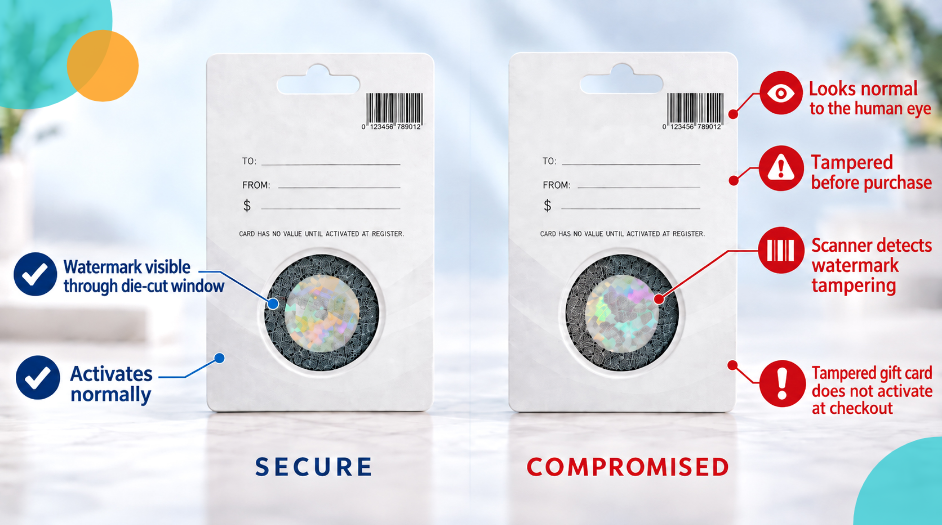
It’s a small but transformative shift that necessitates an intelligent activation system. Rather than relying entirely on packaging to stop tampering, Digimarc’s big idea was to enable the activation layer to digitally detect compromised cards, instantly and automatically, right at the point of sale. So, even if criminals did capture card data and place tampered cards, they wouldn’t activate, stopping the fraud in its tracks.
Digimarc’s R&D team began quietly innovating in the background, leveraging its patented technologies to enable digital identification of tampered cards, as well as coding security updates for store scanners so they can intelligently detect tampered cards.
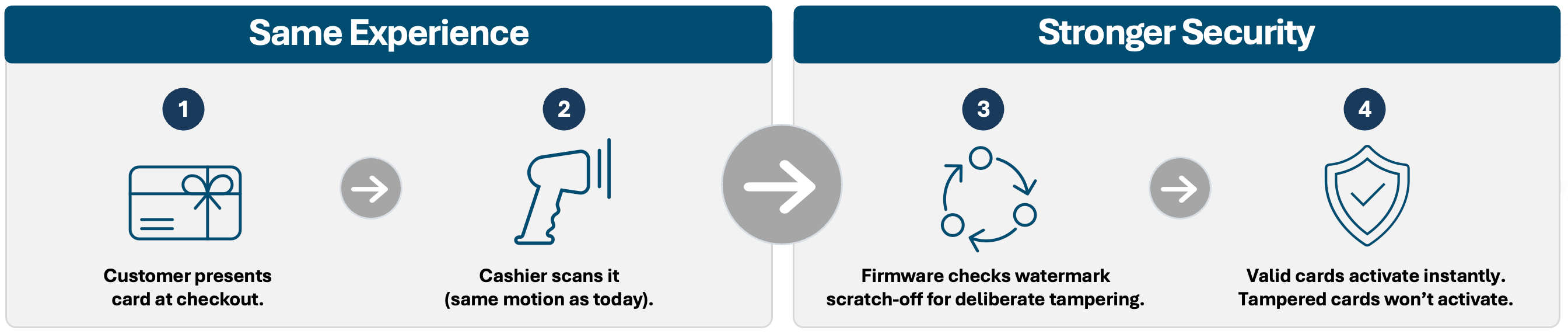
But the big moment for customers came in 2025, when Digimarc worked with strategic partners such as Schnucks Markets, Blackhawk Network, and Zebra Technologies to pilot the new solution. The in-store experience was unchanged: cashiers or consumers simply scanned the back of cards, as they normally would, at registers or kiosks. Digimarc-updated scanners instantly evaluated whether a card was compromised. As shown in the figure, if tampering was detected, the card did not activate.
The pilot ran across 10 retail stores for 10 weeks in St. Louis, with four gift cards from well-known brands. Zero fraud was reported on Digimarc-protected cards (unlike the traditional cards sold in stores during the pilot period) and every untampered card activated quickly and successfully.
Security experts often distinguish between incremental improvements and architectural changes. In the gift card industry, incremental looks like a stronger adhesive, a better or “smarter” label, or a tougher package to open.
But the fact is, over time, every new package design eventually becomes familiar. Every new label can be studied and copied. And every physical defense creates another obstacle that sophisticated fraudsters can see, understand, and eventually figure out how to bypass.
Digimarc’s innovation—the digital identification of tampering and activation-level controls that prevent compromised cards from activating in the first place—has changed the game. Because if a compromised card cannot be activated, the fraud chain breaks down.
The result is next-level security for brands, retailers, and customers, and all without any changes to checkout processes or the customer experience.
No single technology will eliminate gift card fraud entirely. Fraudsters are persistent, creative, and motivated by enormous financial incentives.
But what’s becoming clear to all gift card ecosystem players is the fact that gift card fraud has never been just a packaging problem. It’s also an activation problem. And it’s why over two dozen companies, including some of the biggest brand names and retailers in the U.S., are already exploring, piloting, and deploying our solution.
Indeed, by joining Digimarc in reimagining tamper detection and card activation, the gift card industry may be entering its first true security transformation in a generation.
Share this Blog