By the Digimarc Security Team | Reviewed by Digimarc product specialists with decades of experience deploying content protection across banking, healthcare, and other regulated industries.
The shift to remote and hybrid work has been a boon for employee flexibility and productivity. But it has also exposed a critical gap in data leakage protection: the moment sensitive information appears on a screen where employees or contractors can see it. At that point, even the strongest defenses can lose their grip.
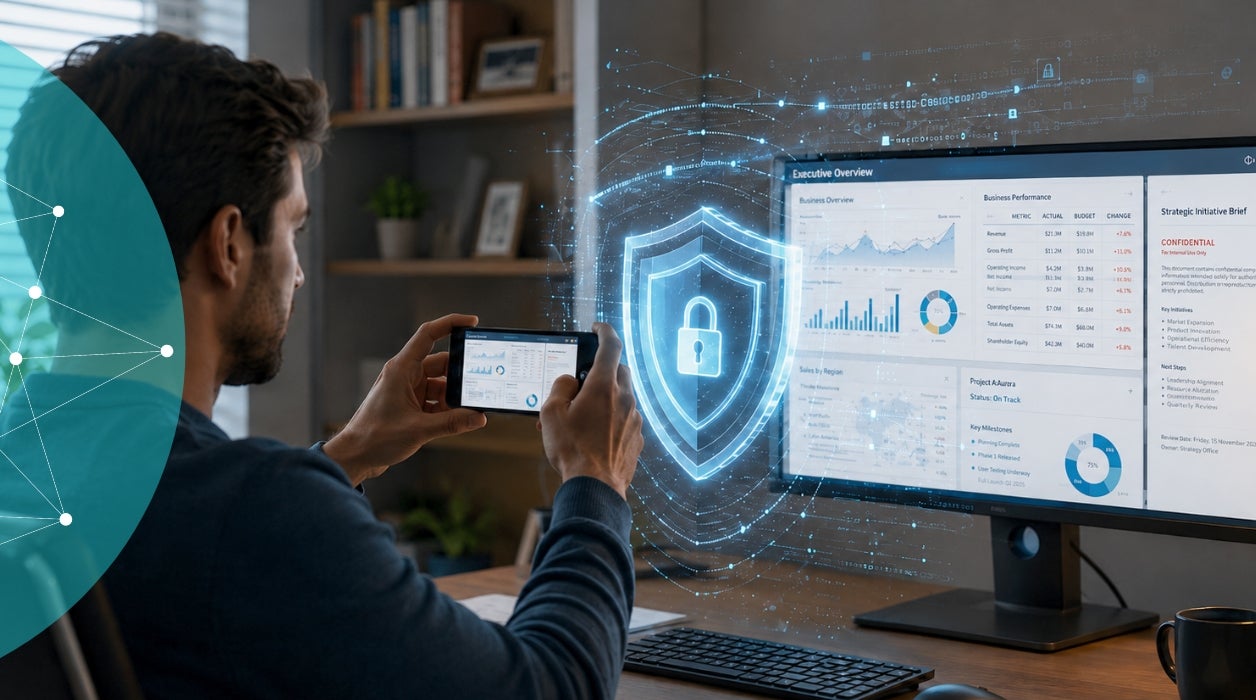
Here is the problem in plain terms: once data is displayed on a screen, it can be captured. Encryption, role-based access, and endpoint DLP can all lose visibility and control. Anyone can take a screenshot or snap a photo with a personal phone and leak that image to social media, Telegram channels, or news sites, often without triggering a single alert.
In a distributed workforce, these low-tech leaks are hard to prevent and notoriously difficult to trace. They are not sophisticated cyber breaches. They are image-based, post-access leaks that can bypass pre-display safeguards because authorized insiders with phones carry them out. This guide explains how to extend your defenses so they finally cover the screen itself.
Why Remote Work Widened the Data Leakage Protection Gap
Incidents of leaked screen images are rising. Three remote-work trends have widened this screen-capture gap and exposed the limits of conventional security tools:
Work-From-Home Trends Remove Oversight
When employees work from home, no one is watching the screen. Personnel reach corporate systems through portals and digital workspaces, with personal phones sitting right next to their PCs. A quick photo captures sensitive information instantly. Because this leaves no digital trail on managed devices, tracing the leak back to its source is nearly impossible without content-level protection.
Employee Portals Aggregate Sensitive Data
Sensitive data now lives in browser-based portals accessible from any device. Digital workspaces such as SAP Work Zone aggregate analytics, dashboards, AI outputs, and business processes in one place. This convenience also concentrates valuable information on single screens, making it faster and easier to photograph. An effective defense has to account for these aggregation points.
BYOD Policies Blur the Security Line
Employee, contractors, partners, and other remote staff frequently use unmanaged personal phones and laptops for work-related purposes. These devices sit outside traditional controls, blurring the line between secure and unsecured environments. As a result, any authorized user can photograph a screen and leak it, regardless of how strong the access rules are.
Why Pre-Access Security Tools Are No Longer Enough
Most organizations already run Zero Trust architectures, advanced DLP stacks, and endpoint protection. These are essential layers. The problem is that their capabilities generally stop at the screen. They often can’t control what happens once information is visible to the human eye, which is exactly when data becomes vulnerable to a camera or screenshot tool.
In hybrid environments, the attack surface expands dramatically. Consider three everyday situations that defeat conventional safeguards:
Each scenario creates a leak that existing data security tools likely cannot trace back to the source. This is the post-access gap most IT teams overlook, and it’s where modern protection must focus next.
Post-Access Protection Built for Hybrid Work
Digimarc's Leak Detection solution closes this gap by adding a covert security layer over internal websites, portals, digital workstations, and content management systems. This data leakage protection layer embeds hidden, user- or session-specific identifiers directly into screenshots and photos of on-screen content. If that content is leaked online or surfaces somewhere it shouldn’t, the embedded identifier enables IT to trace the image back to its source.
The coverage even extends across your wider ecosystem—for example, when partners, suppliers, or vendors access shared data through a portal or intranet. No one needs to know the layer is there. It works behind the scenes with no perceptible impact on user experience, system performance, accessibility, or collaboration tools.
Digimarc’s approach to post access, content-level security has been proven in large-scale, global deployments. In a recent enterprise-wide rollout, the solution protects content accessed through a global content management system across tens of thousands of devices worldwide. The solution generates approximately 55 million covert security layers per year with no reported impact on worker productivity. Now, when a leaked screenshot or photo of a screen surfaces externally, security teams can trace it back to the source, hold bad actors accountable, and prevent future leaks.
The Future of Data Leakage Protection Starts with Post-Access Security
Remote work is here to stay, which means the risk of on-screen leaks will only grow. Now is the time to invest in a persistent, covert, content-level security layer. Digimarc delivers exactly that: seamless, scalable coverage that works wherever your internal or external teams do and slots into your existing DLP stack to complement it with ease.
Traditional security keeps attackers out. Digimarc’s post-access protection addresses what happens after legitimate access is granted—and when sensitive content is most exposed. Used together, these solutions help you to finally close the gap that remote work pried open.
Ready to close the screen-capture gap in your hybrid environment? Watch the Leak Detection overview video or request a demo today to see our post-access content protection solution in action.
Share this Blog